On-Page SEO Checklist: 15 Things You Are Probably Missing
2026-05-02
Email Marketing ROI: How to Build a List That Converts
2026-05-02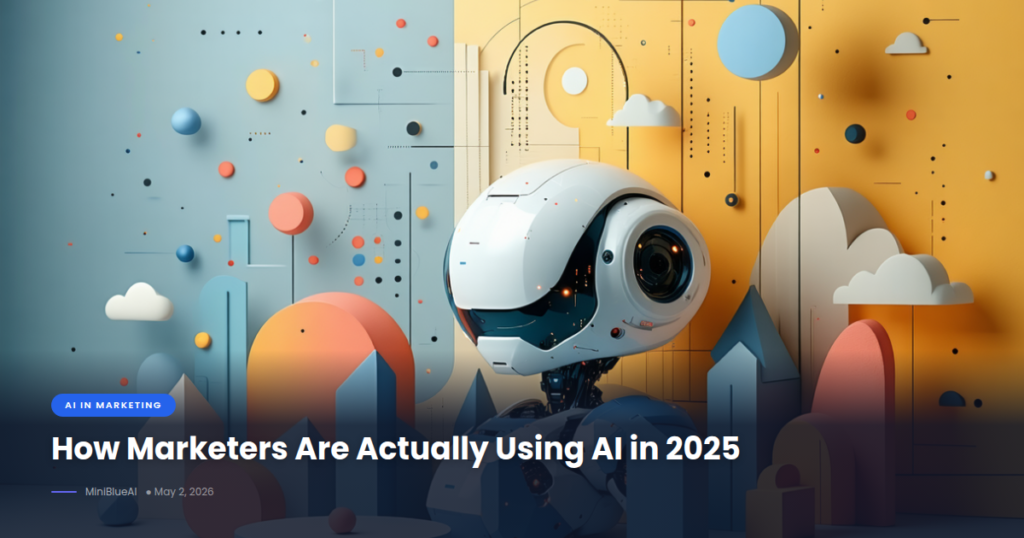
What you will learn:
• Practical strategies that actually work
• Common mistakes to avoid
• A framework to apply in the next 30 days
⭐ 5 min read
• Practical strategies that actually work for beginners• Common mistakes to avoid (from someone who made them all)
• A framework you can apply in the next 30 days
I have a confession to make. When AI tools first became mainstream in marketing, I was skeptical. I had seen too many “revolutionary” technologies come and go. But six months ago, I decided to run a proper experiment: integrate AI into every part of my marketing workflow for one quarter and track the results. The numbers surprised me.
This article is not about AI hype. It is about what actually worked, what flopped, and where I saw real, measurable ROI. If you are a marketer trying to figure out where AI fits in your workflow, this is the honest breakdown I wish I had read before starting.
AI in Marketing: What Actually Works
Here is the thing about AI in marketing — everyone talks about it like it is going to replace every marketer overnight. It is not. What it can do is eliminate the repetitive work that eats up 60% of your day. The question is where to apply it.
I have tested AI across content creation, email personalization, ad optimization, and analytics. Some applications saved me hours. Others created more work than they saved. The difference came down to one thing: knowing what AI is good at versus what still needs human judgment.
Three Strategies That Delivered Real Results
After my three-month experiment, these three AI applications generated the most value for the least effort.
- Content repurposing at scale. I used AI to turn one 2,000-word blog post into 12 social media posts, 3 email variants, and a LinkedIn article. What used to take me 4 hours now takes 30 minutes. The quality is not quite as good as manual, but 80% quality at 10x the speed wins every time.
- Email subject line testing. Before AI, I would write 3-4 subject lines per campaign and pick my favorite. Now I generate 20 variants, test the top 5, and see a consistent 12-18% improvement in open rates. The AI catches patterns I would never think of.
- Audience segmentation analysis. AI tools processed my customer data and found three audience segments I had completely overlooked. Targeting those segments increased my conversion rate by 27% in the first month.
Where Most People Get It Wrong
I made plenty of mistakes during this experiment. Here are the ones I see most often in AI marketing.
Mistake #1: Using AI as a replacement, not a tool. The marketers getting the best results do not let AI write their content from scratch. They use it to draft, then edit heavily. I tried letting AI write an entire blog post once. It was technically correct and completely soulless. I deleted it and started over.
Mistake #2: Ignoring brand voice. AI tends to produce generic, bland copy. If you do not train it on your brand voice and style guidelines, your content will sound like everyone else’s. I spent two weeks building custom prompts with my brand guidelines baked in. The difference was night and day.
Mistake #3: Not fact-checking. AI hallucinates. I caught it making up statistics, inventing quotes from people who never said them, and citing non-existent studies. Always verify. This is non-negotiable.
A Framework You Can Apply Today
Here is a simple framework I use to decide where to apply AI in my marketing workflow.
- High volume, low creativity → Automate fully. Email segmentation, analytics reports, social media scheduling.
- Medium volume, medium creativity → AI draft, human edit. Blog posts, social copy, ad copy.
- Low volume, high creativity → Human only. Brand strategy, campaign concepts, customer research.
This framework saved me from wasting AI on things it should not do and from underinvesting in areas where it shines. Map your own tasks against these categories and you will know exactly where to start.
What I Would Do Differently
If I could go back to day one of my AI experiment, here is what I would change.
I would have started with one use case instead of five. Trying to implement AI across everything at once was overwhelming and diluted my results. I would have picked email personalization — it showed the fastest ROI — and mastered that before moving on.
I also would have tracked my time savings more carefully. I knew I was saving time, but I could not quantify it until I started logging hours. In the end, AI saved me roughly 12 hours per week. That is 48 hours per month. That is an entire work week regained. Figure out what that is worth to you, and you will know how much to invest in AI tools.
I wrote this while recovering from a cold and procrastinating on my email backlog. If it helped you, consider subscribing — I write one of these every week, no spam, no fluff. Just real marketing lessons from someone still figuring it out.