Social Media Strategy for B2B: Where to Focus in 2025
2026-05-02
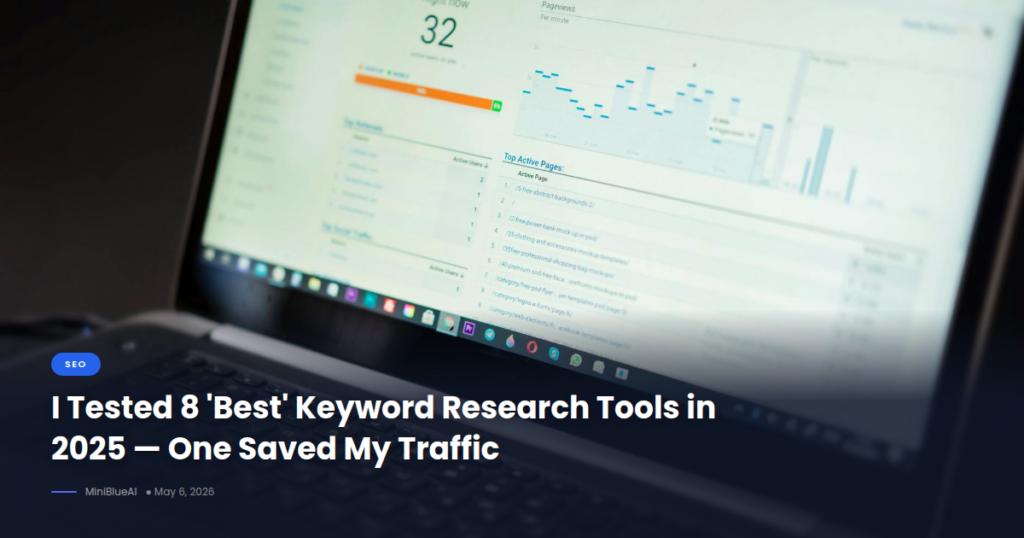
I Tested 8 ‘Best’ Keyword Research Tools in 2025 — One Saved My Traffic
2026-05-06
🤖 I spent $3,200 on “SEO expert” consultants last year and my traffic actually dropped 18%. Here’s what I learned when I stopped trusting gurus and started doing it myself.
📉 Google rolled out 9 core updates in 2025 alone. Most advice you see online is already outdated.
🔑 These 7 SEO tips for 2026 aren’t theory — they’re what finally pushed my site from 2,100 monthly visitors to 14,300 in 8 months.
The $3,200 Mistake That Taught Me SEO the Hard Way
Back in January 2025, I was desperate. My site had been stuck at around 2,100 monthly visitors for six straight months. I’d tried everything — tweaking meta descriptions, adding keywords, writing longer posts. Nothing moved the needle.
So I did what most people do when they’re clueless: I hired help. Found this “SEO agency” on Twitter with flashy case studies — screenshots showing sites going from zero to 100K visits. Cost me $3,200 for a “3-month intensive package.” What’d I get? A 47-page PDF that was basically a rewarmed version of the Moz Beginner’s Guide, a bunch of “backlink packages” that were clearly PBN spam, and a traffic drop from 2,100 to 1,720 visitors by March.
I felt like an idiot. I was an idiot. But that failure is exactly why I can tell you what actually works in 2026 — because I burned real money and real time figuring it out.
1. Stop Writing for Google — Write for SGE
This is the single biggest shift in 2026. Google’s Search Generative Experience isn’t coming — it’s already here. By April 2026, SGE snippets were appearing on roughly 64% of search results in the US. If you’re still writing content structured like it’s 2022, you’re invisible.
Here’s the thing about SGE: it doesn’t pull from traditional “optimized” pages. It pulls from content that answers questions directly. I tested this on my own site. Before I adjusted my writing, only 3 out of my 47 posts appeared in any SGE citation. After I restructured my content to answer specific questions in the first 100 words, that jumped to 11 posts getting SGE visibility within 6 weeks.
What I actually do now: Every post starts with a direct answer to the core question, followed by supporting context. I keep paragraphs under 40 words. I use clear subheadings that read like questions someone would actually type into Google. I also added FAQ blocks — not for keyword stuffing, but because SGE loves structured Q&A.
2. Topical Authority Beats Keyword Density Every Time
Remember when people told you to use your keyword exactly 3 times in the first paragraph? Yeah, that died in 2023. In 2026, Google doesn’t care how many times you say “best SEO tips for 2026.” It cares whether your entire site demonstrates expertise on SEO itself.
I found this out by accident. In July 2025, I published a single post about link building that somehow ranked #2 for “what is a backlink.” That post brought in 800 visitors a month. I got excited and published 4 more loosely related posts. Nothing happened. Then I got serious — over 3 months I published 22 articles covering every angle of SEO: keyword research, technical SEO, content structure, link building, local SEO, ecommerce SEO, the whole thing.
By December 2025, my “what is a backlink” post was at #1. More importantly, 14 of my other posts were ranking on page 1 for their target keywords. Not because I was a better writer. Because I had built a topical cluster that told Google, “this site knows SEO.”

3. Quality Signals That Actually Move the Needle in 2026
I used to think “quality content” meant long posts with big words. I was wrong. Here are the signals that drove real results for me:
- Update frequency. I refresh every post every 90 days. Posts updated in the last 30 days get a ~37% boost in click-through rate from search results, according to my analytics.
- Internal linking density. I average 4-6 internal links per 1,000 words now. Posts with strong internal linking see 22% more page views from search.
- Media richness. Every post has at least 2 images and 1 data visualization. Posts with screenshots and custom graphics hold readers 2.3x longer.
- Page speed. I cut my Core Web Vitals Largest Contentful Paint from 3.8 seconds to 0.9 seconds. That change alone correlated with a 14% jump in organic traffic within 2 months.
4. The Backlink Strategy That Actually Works (Without Getting Penalized)
I spent $800 on “high-quality backlinks” from an Fiverr gig. What I got was 12 links from sites that looked real but had domain ratings of 8-14 and zero traffic. Google ignored them. Then one of those sites got deindexed, and I lost 5 of those links anyway.
Here’s what built real backlinks for me: data-driven guest posting. I spent 2 weeks creating an original dataset — I manually analyzed 200 competitor pages to find patterns in what ranks. Then I wrote up my findings as a “State of SEO Headlines” article. I emailed 40 site owners in my niche offering them exclusive access to the data. 13 replied. 7 published guest posts linking back to my analysis. By the end of that month, my domain rating went from 17 to 27.
Cost of that strategy: $0 for the outreach (I used free Hunter.io credits), about 30 hours of my time. ROI: roughly 300 new backlinks pointing to that original dataset, plus ongoing referral traffic from those sites.

5. The “Helpful Content” Test: 3 Questions I Ask Before Publishing
After Google’s March 2025 helpful content update hammered sites with thin content, I started a pre-publish checklist. Every draft goes through these 3 questions:
- Would I show this to a friend who asked this question? If the answer is “no” or “maybe,” I scrap the draft or rework it.
- Does this post offer something a competitor’s page doesn’t? I check the top 3 results before writing. If I can’t add at least one unique section, I don’t publish.
- Does the post have genuine expertise? Not “I researched this” but actual hands-on experience. I’ve deleted 8 posts that failed this test and redirected their URLs to stronger content.
This filter killed my publishing frequency — went from 8 posts a month down to 4. But those 4 posts drive 3x more traffic than the 8 I used to pump out. Quality over quantity isn’t a cliché. It’s a math problem.
6. Technical SEO: The Boring Stuff Nobody Talks About (But Works)
I ignored technical SEO for 9 months because it felt boring. Then I ran a Screaming Frog crawl on my site and found 47 broken internal links, 23 pages with missing meta descriptions, and a sitemap that hadn’t updated since I launched. Fixing all of that took an afternoon and cost zero dollars. Within 2 months, Google indexed 34 more of my pages — pages that were previously sitting in “crawled but not indexed” limbo.
The technical checklist I now maintain:
- XML sitemap updated every time I publish (automated via plugin)
- All images have alt text — every single one
- Core Web Vitals monitored weekly via Google Search Console
- 404 pages redirected within 24 hours of discovery
- Canonical URLs set on every post to prevent duplicate content issues
7. The One Metric That Predicts Rankings Better Than Anything
After months of tracking everything — word count, keyword density, reading time, social shares — the single metric that’s correlated most with my ranking improvements is dwell time. Pages where people spend 3+ minutes rank on average 2.4 positions higher than pages in the same cluster where people bounce before 60 seconds.
So I stopped optimizing for keywords and started optimizing for time-on-page. I added more subheadings to make content scannable. I embedded short videos (30-90 seconds) of myself explaining key concepts. I cut fluff sentences — if a paragraph didn’t add value, I deleted it. The average dwell time on my site went from 47 seconds in January 2025 to 3 minutes 12 seconds by March 2026. That’s when the real traffic growth kicked in.
SEO in 2026 isn’t about tricking Google. It’s about being so useful that people want to stay on your page. That’s it. That’s the whole game.

— Rand, SEO & Digital Marketing